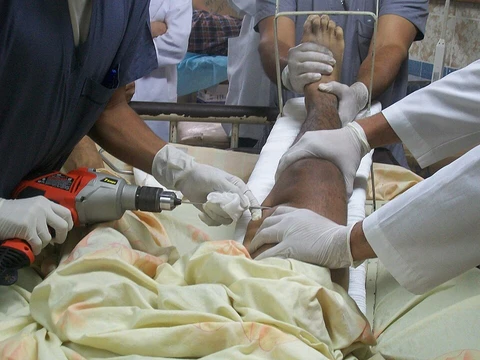
Trauma surgery
Surgical specialty managing acute traumatic injuries via operative and non-operative care.
Trauma surgery is a field of medicine focused on treating injuries from accidents or violence, using both surgery and non-surgical methods, usually in urgent situations. Surgeons in this specialty typically start with a general surgery residency and often add a fellowship in trauma or surgical critical care. They handle the initial resuscitation and stabilization of patients, then continue with evaluation and management, while also leading the trauma team, which includes nurses, support staff, and, at teaching hospitals, resident physicians.
**Training** In the United States, most trauma surgeons work in larger hospitals and complete a one- to two-year fellowship that frequently includes surgical critical care. This allows them to take the American Board of Surgery exam for certification in surgical critical care. In Europe, national surgical boards oversee training and certify subspecialization in trauma surgery, with an official European exam available. Getting adequate training can be challenging. In the U.S., courses like Advanced Trauma Operative Management (ATOM) and Advanced Surgical Skills for Exposure in Trauma (ASSET) offer hands-on operative training for surgeons and trainees. The Advanced Trauma Life Support (ATLS) course is required for most U.S. practitioners who care for trauma patients, including attending physicians in emergency medicine, surgery, and trauma, as well as physician extenders and trainees.
**Responsibilities** Because of their broad critical care training, trauma surgeons can handle most injuries to the neck, chest, abdomen, and limbs. In much of Europe, they treat most musculoskeletal trauma, while neurosurgeons handle central nervous system injuries. In the U.S. and Britain, orthopedic trauma surgeons treat skeletal injuries, and maxillofacial surgeons manage facial injuries. The involvement of other specialists—like cardiothoracic surgeons, plastic surgeons, vascular surgeons, and interventional radiologists—varies widely between hospitals. Trauma surgeons must be skilled in many general surgical, thoracic, and vascular procedures and make complex decisions quickly, often with limited time and incomplete information. They also need expertise in intensive care medicine. Their work hours are irregular, with significant night, weekend, and holiday shifts. Most trauma patients have multiple injuries affecting different body sy
- field
- Surgery
- subspecialty
- Trauma surgery, surgical critical care, acute care surgery
- training
- General surgery residency plus 1- to 2-year trauma-surgery fellowship (often including surgical critical care)
- key_courses
- ATLS, ATOM, ASSET (US); ATLS and Definitive Surgical Trauma Skills (UK)
- first_US_civilian_trauma_surgeon
- Dr. George E. Goodfellow
- notable_early_procedure
- First recorded laparotomy for gunshot wound (July 13, 1881)
Lore & Background
Dr. George E. Goodfellow is credited as the United States' first civilian trauma surgeon. He opened a medical practice in Tombstone, Arizona Territory, in November 1880. On July 13, 1881, he performed the first recorded laparotomy to treat a miner's gunshot wound, suturing six holes in the man's organs. Goodfellow treated numerous outlaw cowboys and the Earp brothers after the gunfight at the O.K. Corral, and pioneered sterile techniques using lye soap or whisky.
Reader's Guide
Trauma surgery has evolved from the pioneering work of Dr. George E. Goodfellow in the 1880s to a formal subspecialty with structured training. Goodfellow's use of sterile techniques and laparotomy set early standards. By the late 1950s, mandatory laparotomy became standard for abdominal penetrating trauma. Today, trauma surgeons in the US typically complete a 1- to 2-year fellowship and may certify in surgical critical care. In Europe, national surgical boards supervise training and certification. The field increasingly overlaps with emergency general surgery under the term acute care surgery. Trauma surgeons must be proficient in a wide range of procedures and critical care, working irregular hours. Courses like ATLS, ATOM, and ASSET provide essential training. The specialty continues to adapt, with non-operative management becoming more common for certain injuries.
Did You Know?
- Dr. George E. Goodfellow performed the first recorded laparotomy for a gunshot wound on July 13, 1881.
- Goodfellow treated Deputy U.S. Marshal Virgil Earp and Assistant Deputy U.S. Marshal Morgan Earp after the gunfight at the O.K. Corral.
- In the US, trauma surgeons often take emergency general surgery calls, a field combining both called acute care surgery.
- The Advanced Trauma Life Support (ATLS) course is required for most US practitioners who care for trauma patients.
More in Traumatology 1-24
Spotted an error? Know more?
This is a living reference — every entry is fact-audited, and reader corrections feed straight into our audit queue. Suggest an edit · See this site's audit record