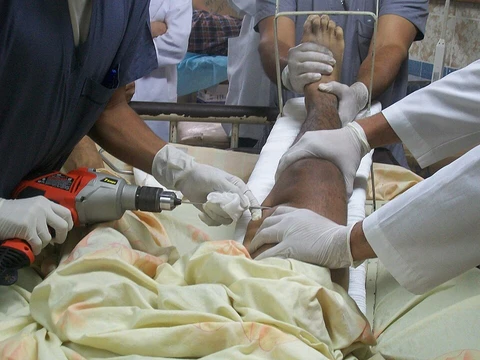
Advanced trauma life support
Standardized trauma training program using the ABCDE approach.

Wikipedia / Wikimedia Commons
Advanced trauma life support, or ATLS, is a course created by the American College of Surgeons to train doctors in handling acute trauma. It aims to provide a simple, standardized method for treating trauma patients, and was originally designed for situations with just one doctor and one nurse. Over 1 million physicians across more than 80 countries have taken the program; outside North America, it is often called Early Management of Severe Trauma. The core idea is to address the most immediate threat to life first. The program also stresses that a lack of a definitive diagnosis or detailed medical history should not delay life-saving treatment, with the most urgent interventions done early. Despite its widespread use, no high-quality evidence currently proves that ATLS improves patient outcomes, though at least one large-scale trial is underway.
The initial and most critical part of trauma assessment is the primary survey. During this phase, life-threatening injuries are identified while resuscitation begins. A simple mnemonic—ABCDE—guides the order of priorities.
**Airway maintenance** starts with stabilizing the cervical spine. If the patient can speak, the airway is likely open. An unconscious patient may lose the ability to maintain their own airway, which can be opened with a chin lift or jaw thrust. Airway adjuncts may be needed. If the airway is blocked by blood or vomit, suctioning clears it. If obstruction persists, an endotracheal tube is inserted.
**Breathing and ventilation** involves examining the chest through inspection, palpation, percussion, and auscultation. Signs like subcutaneous emphysema or tracheal deviation must be identified. The goal is to detect and manage six life-threatening thoracic conditions: airway obstruction, tension pneumothorax, massive haemothorax, open pneumothorax, flail chest with pulmonary contusion, and cardiac tamponade. Inspection reveals flail chest, tracheal deviation, penetrating injuries, and bruising. Palpation finds subcutaneous emphysema. Percussion and auscultation identify tension pneumothorax and haemothorax.
**Circulation with bleeding control** focuses on hemorrhage, the leading preventable cause of post-injury death. Significant blood loss causes hypovolemic shock. Two large-bore IV lines are placed, and crystalloid solution may be given. If the patient does not respond, type-specific blood—or O-
- field
- Trauma medicine
- developed by
- American College of Surgeons
- year of first course
- 1978
- number trained
- over 1 million doctors
- countries taught
- over 80
- known for
- ABCDE primary survey mnemonic
Lore & Background
ATLS has its origins in the United States in 1976, when James K. Styner, an orthopedic surgeon piloting a light aircraft, crashed his plane into a field in Nebraska. His wife Charlene was killed instantly and three of his four children sustained critical injuries. Styner found the emergency care at the small regional hospital inadequate and inappropriate, declaring: 'When I can provide better care in the field with limited resources than what my children and I received at the primary care facility, there is something wrong with the system and the system has to be changed.' Upon returning to work, he set about developing a system for saving lives in medical trauma situations. Styner and his colleague Paul 'Skip' Collicott, with assistance from advanced cardiac life support personnel and the Lincoln Medical Education Foundation, produced the initial ATLS course which was held in 1978. In 1980, the American College of Surgeons Committee on Trauma adopted ATLS and began US and international dissemination of the course.
Reader's Guide
The ATLS program is now widely accepted as the standard of care for initial assessment and treatment in trauma centers. Its premise is to treat the greatest threat to life first, and it advocates that the lack of a definitive diagnosis and a detailed history should not slow the application of indicated treatment for life-threatening injury. The primary survey uses the mnemonic ABCDE: Airway maintenance with cervical spine stabilization, Breathing and ventilation, Circulation with bleeding control, Disability/Neurologic assessment, and Exposure and environmental control. However, to date, there is no high-quality evidence to show that ATLS improves patient outcomes, but at least one large-scale trial is ongoing. The program has also influenced military medicine through the Battlefield Advanced Trauma Life Support (BATLS) protocol, which adds a 'c' for catastrophic bleeding. Alternatives such as mannequin surgical simulators have been adopted in many training centers, and the Anaesthesia Trauma and Critical Care (ATACC) course represents a next level for trauma care post ATLS certification.
Did You Know?
- The ATLS course was first held in 1978, developed by James K. Styner and Paul 'Skip' Collicott.
- The primary survey uses the mnemonic ABCDE, starting with Airway maintenance and cervical spine stabilization.
- There is no high-quality evidence that ATLS improves patient outcomes, though a large-scale trial is ongoing.
- In military medicine, the ATLS protocol is modified to cABCDE, with 'c' standing for catastrophic bleeding.
More in Traumatology 1-24
Spotted an error? Know more?
This is a living reference — every entry is fact-audited, and reader corrections feed straight into our audit queue. Suggest an edit · See this site's audit record