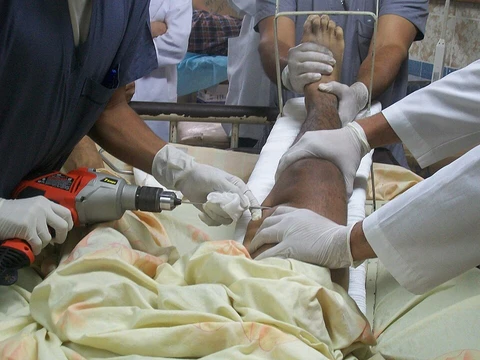
Compassion fatigue
Compassion fatigue is the negative cost of caring in helping professions.

Wikipedia / Wikimedia Commons
Compassion fatigue is a concept in traumatology that describes the traumatic stress caused by repeatedly caring for people who have been through trauma or by being exposed to the disturbing details of such events. It’s an indirect form of trauma, different from experiencing a traumatic event firsthand. The term is often used interchangeably with secondary traumatic stress (STS), which is sometimes called the negative cost of caring. While STS is the more common term in academic studies, recent research has pointed to some differences between the two.
The phrase was first used in 1992 by Carla Joinson to explain the toll that constant exposure to patient emergencies was taking on hospital nurses. However, the term had appeared as early as 1961 and gained wider attention in 1985 when Bob Geldof said it was why he stopped his charity work after Live Aid. Charles Figley, a key figure in traumatology, helped define it as the “cost of caring” for people in helping roles. To some degree, “compassion fatigue” is seen as a gentler term for what academics call secondary traumatic stress. It has also been referred to as secondary victimization, vicarious traumatization, and secondary survivor, among other names. Related conditions include rape-related family crisis and the effects on female partners of war veterans.
People with compassion fatigue may experience a range of symptoms, such as trouble concentrating, numbness, helplessness, irritability, lack of satisfaction, withdrawal, physical aches, exhaustion, anger, or a reduced ability to feel empathy. They might also turn to negative coping behaviors like drinking or using drugs. Professionals in trauma-exposed jobs may start taking more time off or consider leaving their field. Many symptoms overlap with PTSD, but the key difference is that PTSD comes from direct trauma, while compassion fatigue comes from secondary or indirect exposure.
Several factors raise the risk of compassion fatigue. In workplaces like healthcare, a “culture of silence” where stressful events (like deaths in an ICU) are not discussed can make things worse. Long hours, understaffing, workplace rudeness, and feeling dismissed by managers also contribute. A lack of awareness about symptoms and poor training on the risks of trauma-exposed work lead to higher rates of STS. The severity of symptoms usually depends on three things: how close the
- field
- Traumatology
- known_for
- Concept of compassion fatigue as the negative cost of caring in helping professions
- coined_by
- Carla Joinson
- year_coined
- 1992
- related_terms
- Secondary traumatic stress, vicarious traumatization, secondary survivor
Lore & Background
Compassion fatigue has been studied by the field of traumatology, with Charles Figley playing a pivotal role by characterizing it as the 'cost of caring' experienced by individuals in helping professions. The term was introduced to the literature in 1992 by Carla Joinson, though the phrase had been in use as early as 1961, and was popularized in 1985 when Bob Geldof cited it as his reasoning for ending his charity work after Live Aid. To a certain extent, the term is considered somewhat euphemistic and is used as a substitute for its academic counterpart, secondary traumatic stress.
Reader's Guide
Compassion fatigue is significant because it highlights the psychological toll on professionals and informal caregivers who repeatedly encounter trauma indirectly. It affects a wide range of workers, including doctors, nurses, paramedics, police officers, firefighters, social workers, teachers, clergy, journalists, and animal welfare workers, as well as family caregivers of chronically ill individuals. Symptoms include lowered concentration, numbness, irritability, exhaustion, anger, reduced empathy, and increased negative coping behaviors like alcohol and drug use. Risk factors include organizational attributes such as a 'culture of silence,' long work hours, short-staffing, and lack of awareness or training. Between 16% and 85% of health care workers in various fields develop compassion fatigue, with studies showing 86% of emergency room nurses and more than 25% of ambulance paramedics meeting criteria for severe post-traumatic symptoms. The concept has spurred development of assessment tools like the Compassion Fatigue Self Test and the Professional Quality of Life Scale (ProQOL). Its legacy lies in prompting healthcare institutions to support employees' emotional needs to maintain therapeutic relationships and reduce workforce attrition.
Did You Know?
- The term 'compassion fatigue' was coined in 1992 by Carla Joinson to describe the negative impact on hospital nurses.
- Compassion fatigue is considered a form of secondary traumatic stress, arising from indirect exposure to trauma rather than direct experience.
- Between 16% and 85% of health care workers in various fields develop compassion fatigue, with 86% of emergency room nurses meeting criteria in one study.
- The ProQOL assessment contains three sub-scales: compassion satisfaction, burnout, and compassion fatigue/secondary traumatic stress.
More in Traumatology 1-24
Spotted an error? Know more?
This is a living reference — every entry is fact-audited, and reader corrections feed straight into our audit queue. Suggest an edit · See this site's audit record