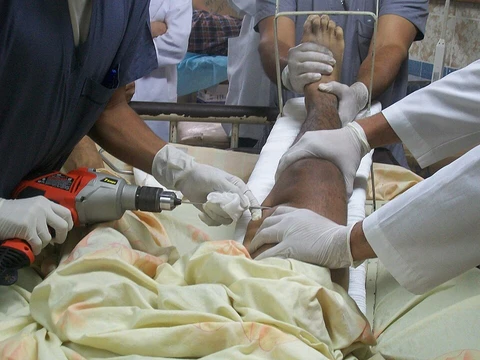
Trauma in children
Pediatric trauma requires specialized care due to anatomical and physiological differences.
Pediatric trauma covers any serious physical injury sustained by an infant, child, or adolescent. Because children’s bodies are built differently from adults’—both in structure and in how they work—treating them requires a distinct approach. Their internal organs sit closer together, which makes them more vulnerable to injury, and their smaller size means they lose body heat faster, raising the risk of hypothermia. A lower weight-to-surface-area ratio also contributes to heat loss, and their compact bodies often suffer multiple injuries from a single impact.
Weighing a child accurately is a critical step in emergency care. Several methods exist, including the Broselow tape, the Leffler formula, and the Theron formula. The Broselow tape works best for children weighing 25 kilograms or less, while the Theron formula is more reliable for those over 40 kilograms.
To gauge injury severity, doctors use scoring systems like the Injury Severity Score or a modified Glasgow Coma Scale. More complex tools, such as the Revised Trauma Score, APACHE II, and SAPS II, add physiological data to help with triage, treatment decisions, and prognosis. But these adult-focused measures have serious limits with children, so providers often turn to pediatric-specific versions. The Pediatric Glasgow Coma Scale, for instance, is designed for kids who haven’t yet learned to speak. The Pediatric Trauma Score (PTS) was created to reflect children’s particular vulnerabilities, factoring in body weight and airway size. Scores range from -6 to +12; the lower the score, the higher the risk of death. A PTS above 8 carries a 9% mortality risk, while a score of 0 or below is linked to a 100% mortality rate. Despite some research showing no clear advantage over the Revised Trauma Scale, the PTS remains the most common tool for assessing pediatric trauma severity.
Managing these injuries demands expertise in the physiological, anatomical, and developmental differences between children and adults. In the field, treating pediatric patients can be complicated by a lack of knowledge and resources. While outcomes at adult trauma centers are only slightly different, the best care for a seriously injured child is at a pediatric trauma center. A 2006 study found that children treated at such centers have a lower risk of death—yet only about 10% of injured children actually receive care there. The high
- field
- Pediatric trauma care
- known_for
- Unique challenges in pediatric trauma management, including weight estimation methods and the Pediatric Trauma Score
- mortality_rate
- Serious injury kills nearly 10,000 children in America each year (2010 data)
- leading_cause
- Injury is the leading cause of death for children under 18 in the United States, greater than all other causes combined
Lore & Background
Pediatric trauma care differs from adult trauma care due to anatomical and physiological differences. For example, children's internal organs are closer together, increasing injury risk. Their lower weight-to-surface-area ratio makes them prone to hypothermia, and smaller body size often leads to poly traumatic injury. A 2006 study found that the risk of death for injured children is lower when care is provided in pediatric trauma centers, yet only about 10% of injured children are treated at such centers. The highest mortality rates occur in children treated in rural areas without access to trauma centers.
Weight estimation is critical in pediatric trauma management. Methods include the Broselow tape, Leffler formula, and Theron formula. The Broselow tape is most accurate for children ≤25 kg, while the Theron formula performs better for patients weighing >40 kg. The Pediatric Trauma Score (PTS) was developed to reflect children's vulnerability, with scores ranging from -6 to +12. Mortality is estimated at 9% with a PTS > 8 and 100% with a PTS ≤ 0.
Epidemiologically, pediatric trauma accounted for 59.5% of all mortality for children under 18 in 2004. In the US, approximately 16,000,000 children visit emergency rooms due to injury each year. Male children are injured twice as often as females. Some injuries, like chemical eye burns from household cleaning supplies, are more common in young children. Penetrating injuries often result from writing utensils and common household objects.
Reader's Guide
Pediatric trauma is a significant public health issue, being the leading cause of death and permanent paralysis for children in the United States. The field emphasizes that children are not simply small adults; their unique anatomy and physiology require specialized assessment and treatment. The development of tools like the Pediatric Trauma Score and weight estimation methods (Broselow tape, Theron formula) highlights efforts to tailor care to this population. The 2006 study's finding that pediatric trauma centers yield lower mortality rates underscores the importance of specialized care, yet the fact that only 10% of injured children receive such care points to systemic gaps, particularly in rural areas. The high mortality and morbidity rates—nearly 10,000 deaths annually in the US—demonstrate the ongoing need for improved access and training. The field's legacy includes modified classification systems like the Pediatric Glasgow Coma Scale and the recognition that definitive care is best reached at a pediatric trauma center, despite some research showing no benefit between the PTS and the revised trauma scale.
Did You Know?
- A 2006 study concluded that the risk of death for injured children is lower when care is provided in pediatric trauma centers rather than in non-pediatric trauma centers.
- The Broselow tape is the most accurate method for weight estimation in children ≤25 kg, while the Theron formula performs better for patients weighing >40 kg.
- Pediatric trauma accounted for 59.5% of all mortality for children under 18 in 2004.
- In the US, approximately 16,000,000 children go to a hospital emergency room due to some kind of injury every year.
More in Traumatology 1-24
Spotted an error? Know more?
This is a living reference — every entry is fact-audited, and reader corrections feed straight into our audit queue. Suggest an edit · See this site's audit record