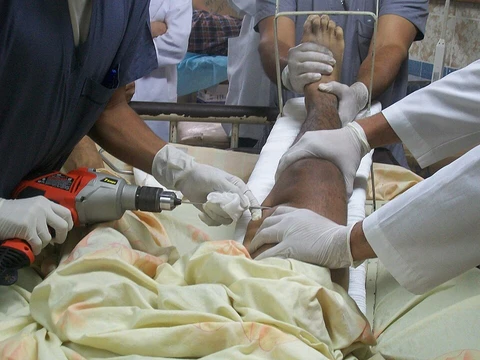
Penetrating trauma
Open wound injury from object piercing skin and entering tissue.
Penetrating trauma is a type of open wound where an object breaks the skin and goes into the body, leaving a deep but narrow entry hole. This is different from blunt trauma, where the skin might stay intact even if deeper damage occurs. The object that caused the injury might stay inside, come back out the way it went in, or go all the way through and create a separate exit wound. When it passes completely through, it is called perforating trauma; the term penetrating trauma usually means the object does not exit. In gunshot wounds, perforating trauma typically has an entrance wound and a larger exit wound.
This kind of injury can be caused by a foreign object or by pieces of a broken bone. It is most common in violent crime or combat, often from gunshots or stabbings. Penetrating trauma is dangerous because it can harm internal organs and carries risks of shock and infection. How serious it is depends on which body parts are hit, what the object is like, and how much energy it transfers to the tissues. Doctors may use X-rays or CT scans to assess the injury, and treatment can involve surgery to fix damaged structures or remove foreign objects. Spinal motion restriction is linked to worse outcomes after penetrating trauma and should not be done routinely.
**Mechanism**
When a missile passes through tissue, it slows down and spreads kinetic energy into the tissue. The projectile’s speed matters more than its mass for damage, because kinetic energy increases with the square of the velocity. Besides the direct injury from the object, there can be secondary injuries, such as from a blast. The path of a projectile can be guessed by drawing a line from the entry to the exit wound, but the actual track may change due to ricochet or differences in tissue density. In a cut, skin discoloration and swelling happen because blood vessels rupture, letting blood and fluid escape, along with other injuries that interrupt circulation.
**Cavitation**
*Permanent*: Low-velocity items like knives and swords are usually hand-driven and only damage the area they directly touch. The space left by destroyed tissue as the object passes through is called permanent cavitation.
*Temporary*: High-velocity objects are typically projectiles from high-powered rifles like assault or sniper rifles. Medium-velocity projectiles include bullets from handguns, shotguns, and submachine guns.
- field
- Trauma surgery, emergency medicine
- known_for
- Classification of penetrating vs. perforating trauma; association with cavitation injuries
- mechanism
- Kinetic energy transfer from projectile; velocity more important than mass
- cavitation_types
- Permanent cavitation (low-velocity objects) and temporary cavitation (medium- and high-velocity projectiles)
- common_causes
- Gunshots, stabbings, industrial accidents, bone fragments
Lore & Background
Penetrating trauma is defined by an object piercing the skin and entering tissue, creating a deep but narrow entry wound. In contrast, blunt trauma may cause deep damage without breaking the skin. The penetrating object may remain, exit via the same path, or pass through entirely; when it passes through, it is called perforating trauma, associated with an entrance and often larger exit wound. Penetrating trauma can be caused by foreign objects or fragments of broken bone, and is commonly seen in violent crime or armed combat from gunshots and stabbings.
Reader's Guide
Penetrating trauma is significant because it can damage internal organs and presents risks of shock and infection. Severity varies widely depending on body parts involved, object characteristics, and energy transmitted. Assessment may involve X-rays or CT scans, and treatment may include surgery to repair structures or remove foreign objects. Notably, spinal motion restriction is associated with worse outcomes and should not be done routinely. The mechanism involves kinetic energy transfer, with velocity being more important than mass. Low-velocity objects cause permanent cavitation, while medium- and high-velocity projectiles cause temporary cavitation, which can severely damage delicate tissues like the liver, spleen, kidney, and brain. Penetrating head trauma has a high mortality rate, with only a third surviving to hospital. Chest wounds have a mortality rate under 10%, while abdominal trauma can be life-threatening due to profuse bleeding. Management has evolved from mandatory laparotomy to more conservative strategies.
Did You Know?
- Penetrating trauma is distinguished from perforating trauma: the latter involves an exit wound, while the former does not.
- The velocity of a projectile is a more important factor than its mass in determining damage, as kinetic energy increases with the square of the velocity.
- Temporary cavitation can cause the liver to disintegrate if enough energy is transferred.
- Spinal motion restriction is associated with worse outcomes in penetrating trauma and should not be done routinely.
More in Traumatology 1-24
Spotted an error? Know more?
This is a living reference — every entry is fact-audited, and reader corrections feed straight into our audit queue. Suggest an edit · See this site's audit record