Outline of trauma and orthopedics
Surgical branch treating musculoskeletal conditions via operative and nonoperative means.
Trauma and orthopedics is a surgical field focused on the musculoskeletal system. Orthopedic surgeons address issues like sports injuries, degenerative diseases, infections, bone tumors, and congenital limb deformities through both operations and non-surgical methods. Within this field, trauma surgery and traumatology specifically handle fractures, major trauma, and patients with multiple injuries using operative care.
The discipline splits into elective and trauma branches. Elective areas include foot and ankle surgery, soft-tissue knee reconstruction, knee and hip arthroplasty, spinal surgery, upper limb (shoulder and elbow) work, wrist and hand surgery, osteosarcoma and limb reconstruction, and peripheral nerve repair. Trauma surgery covers acute injuries, while pediatric and congenital osteochondrodysplasia deals with childhood bone and cartilage disorders.
Key concepts in managing trauma follow principles like advanced trauma life support, emergency management, and triage. Basic sciences underpin orthopedics, including anatomy of cartilage, bone types (cortical, cancellous, long, short, flat, irregular, sesamoid), bone regions (epiphysis, metaphysis, diaphysis), and joints (synovial, fibrous, cartilaginous). Physiology covers bone healing and ossification. Pathology includes fracture types (spiral, avulsion, stress, burst, compression, pathologic), arthritis (osteoarthritis, septic), osteochondropathy, osteopathies (osteoporosis, osteomyelitis, pseudarthrosis), chondropathies, and sarcomas like bone tumors (osteoma) and cartilage tumors (chondroma).
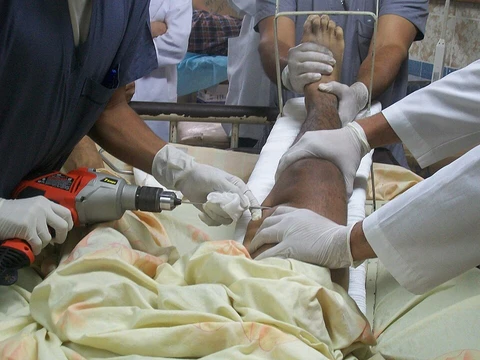
Orthopedic diagnostics rely on examination and radiography. Treatments involve reduction, splinting, casting, traction, and fixation methods such as internal fixation, intramedullary rods, and external fixation. Rehabilitation uses physical therapy and orthotics. Descriptive terms include displacement and comminution. Common procedures are arthroplasty, arthrocentesis, osteotomy, distraction osteogenesis, bone grafting, and arthrodesis. Biomechanics, orthopedic implants, and computer-assisted surgery are also relevant.
Major organizations include the British Orthopaedic Association, American Academy of Orthopaedic Surgeons, and AO Foundation. Key publications are the Journal of Bone and Joint Surgery, Journal of Orthopedics, Journal of Orthopedic Trauma, Journal of the American Academy of Orthopedic Scie
- field
- Trauma and orthopedics
- sub-specialty
- Trauma surgery and traumatology
- key branches
- Elective, Foot and ankle, Spinal, Upper limb, Wrist & hand, Trauma surgery, Paediatric and congenital osteochondrodysplasia
- common procedures
- Arthroplasty, Arthrocentesis, Osteotomy, Distraction osteogenesis, Bone grafting, Arthrodesis
- major organizations
- British Orthopaedic Association, American Academy of Orthopaedic Surgeons, AO Foundation
- key publications
- Journal of Bone and Joint Surgery, Journal of Orthopedic Trauma, New England Journal of Medicine
Lore & Background
The outline of trauma and orthopedics covers a wide range of topics including principles of managing trauma such as advanced trauma life support, emergency management, and triage. Basic sciences in orthopedics include anatomy of bone types (cortical, cancellous, long, short, flat, irregular, sesamoid), joints (synovial, fibrous, cartilaginous), and physiology of bone healing and ossification. Pathology includes bone fractures (spiral, avulsion, stress, burst, compression, pathologic), arthritis (osteoarthritis, septic arthritis), osteopathies (osteoporosis, osteomyelitis, pseudarthrosis), and bone tumors (osteoma, chondroma).
Reader's Guide
The outline serves as a comprehensive reference for the field of trauma and orthopedics, detailing its branches, history, concepts, organizations, and influential figures. It highlights the dual surgical and nonsurgical approach to treating musculoskeletal issues, from elective procedures like hip and knee arthroplasty to trauma surgery for fractures and multiply-injured patients. The inclusion of diagnostic methods (radiography, examination), treatment techniques (reduction, splinting, casting, traction, fixation), and rehabilitation (physical therapy, orthotics) provides a structured overview. Key organizations such as the British Orthopaedic Association and the American Academy of Orthopaedic Surgeons, along with publications like the Journal of Bone and Joint Surgery, underscore the field's professional and academic framework. The outline also notes influential persons including Hugh Owen Thomas, considered the father of orthopaedic surgery in Britain, and John Charnley, an English pioneer of hip replacements.
Did You Know?
- Orthopedic surgeons use both surgical and nonsurgical means to treat musculoskeletal injuries.
- Trauma surgery and traumatology is a sub-specialty dealing with fractures, major trauma, and the multiply-injured patient.
- Hugh Owen Thomas is considered the father of orthopaedic surgery in Britain.
- John Charnley was an English pioneer of hip replacements.
More in Traumatology 1-24
Spotted an error? Know more?
This is a living reference — every entry is fact-audited, and reader corrections feed straight into our audit queue. Suggest an edit · See this site's audit record